

Sample SQE Smart Synopsis Note
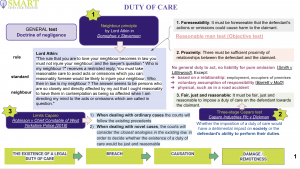
Smart Synopsis Notes are designed using well-researched memory techniques that dramatically improve retention. Instead of long text, each note is presented as a one-page visual system, like the Duty of Care example
🔗 See the System, Not the Pieces
The notes don’t simply list information. They show how different parts connect.
For example, on the Duty of Care slide:
- Caparo Test is numbered 1-2-3, linked with colored arrows.
- Robinson limits are placed as a correction to Caparo, visually modifying the rule.
- Omissions and exceptions are grouped as a branch related to proximity.
📌 Memory benefit: The more connections you see, the easier retrieval becomes. You remember the “map”, not random facts.
👁 You Learn by Observing, Not Reading
Unlike traditional notes, these are processed visually, not mechanically read.
- You explore the structure, arrows, colours, cases placed in positions of meaning.
- You memorise patterns (e.g., 1-2-3 test, exceptions, leading cases).
📌 Better recall: Visual encoding + spatial memory = better recall than linear text.
🎨 Visual Cues Make You Remember
- Key tests use numbers
- Key cases use distinct bubbles
- Exceptions use bullet arrows and colour
- Concepts use shapes (boxes, flows)
On the Duty of Care page, e.g.:
- Caparo = yellow arrow box
- Robinson correction = green correction bubble
- Neighbour principle = purple bubble
📌 Close your eyes: remember the picture like a photo.
This is called visuo-spatial memory, used in high-performance learning.
💡 Initial Difficulty = Better Learning
At first, you must think through the page, not passively read it.
That effort forces deep processing → that is where real memory forms.
- Neuroscience principle: Effort strengthens long-term memory (desirable difficulty theory).
- That’s why after a few days, students suddenly realise:
“I remember so much more than from reading a book.”