


As the Solicitors Qualifying Examination continues to establish itself as the primary route to qualification in England and Wales, it remains a uniquely broad and international assessment, open to candidates from across the world. This includes not only UK law graduates, but also foreign-qualified lawyers, career changers, candidates with limited or no prior legal background, and a growing number of self-preparing students. As a result, selecting the right SQE books, SQE manuals, and SQE1 study materials has become an increasingly important and often difficult decision.
If you’re preparing for SQE, our specialised resources are here to guide you every step of the way:
SQE1 Course
SQE1 one-to-one
SQE2 Training
SQE2 Mocks
Retake SQESQE: Lack of Provider Regulation and Consumer Risk
This challenge is further intensified by an important reality that many candidates may not fully appreciate at the outset:
While the Solicitors Regulation Authority regulates the SQE assessment itself, it does not regulate, quality-assure, academically vet, or formally verify the identity or broader credibility of SQE preparation providers operating on the wider market. Although the SRA may list certain providers or preparation options for informational purposes, such listings should not be interpreted as formal endorsement, academic approval, or quality certification of those providers’ services, standards, or commercial practices.
In practical terms, this means that candidates may encounter an extremely broad range of providers without substantive SRA scrutiny as to:
- identity verification,
- academic quality,
- teaching competence,
- educational standards,
- practical methodology, or
- broader consumer reliability.
This highly open-market approach to SQE preparation, while intended to increase accessibility and reduce costs, may also produce the opposite effect for some candidates, especially those self-preparing for the SQE1.
In practice, a largely unregulated global marketplace can expose SQE candidates — particularly self-preparing students, foreign-qualified lawyers, and especially resitters — to significant vulnerability. Those who have previously failed are often under considerable emotional and professional pressure, making them particularly susceptible to aggressive sales tactics, unrealistic promises, or manipulation by highly experienced sales actors who may operate from anywhere in the world, often far removed from the practical realities of the legal education market in England and Wales.
For international candidates or those unfamiliar with the pre-SQE legal education landscape, this environment can be especially confusing. The SQE era has rapidly expanded the market, flooding it with a vast range of preparation services, providers, and commercial claims of highly variable quality.
This is one of the principal reasons we launched this review series.
Our goal is to provide clearer, more independent guidance for candidates — particularly those outside the jurisdiction and self-studying for the SQE — so they can better understand the resources available, distinguish quality from marketing, and make safer decisions in an increasingly crowded SQE preparation market.
There is also a further professional risk associated with the broader SQE preparation market which we will only briefly outline here.
First, candidates should remain mindful that this is ultimately their own professional qualification. Any preparation route pursued should be fair, ethical, and consistent with the standards expected of future solicitors. Seeking or obtaining any improper or unfair advantage may carry serious consequences if later discovered.
Second, aspiring solicitors are already expected to demonstrate the core professional principles of honesty and integrity. These are not abstract concepts reserved only for post-qualification practice. Conduct during the qualification process itself may become highly relevant to future character and suitability considerations.
Put simply: Your route to qualification matters, not just the result.
Candidates should therefore approach SQE preparation carefully, ensuring that their methods, providers, and conduct align with the professional standards they ultimately seek to join. Any serious concerns arising later — even after admission — may carry direct regulatory consequences.
Oxford University Press SQE Prep & Practice (SQE1): Beginning Our SQE Books and Manuals Review Series
As part of this review series examining major SQE books, SQE manuals, and SQE1 study resources, it is only fitting that we begin with one of the oldest, most academically established, and traditionally respected legal publishers in the United Kingdom: Oxford University Press.
It is one of the oldest university publishers in the world. Its origins trace back to the University of Oxford’s early printing operations in the fifteenth century, with formal publishing rights developing over subsequent centuries. Today, OUP operates as part of the University of Oxford and functions with an educational mission, reinvesting much of its work into scholarship, research, and academic advancement rather than existing purely as a commercial training business.
For over 500 years, OUP has built a formidable reputation for:
- academic excellence,
- legal scholarship,
- educational reliability, and
- trusted professional publishing.
This matters‼️
Unlike many modern SQE providers, Oxford University Press was not created simply to capitalise on the SQE market or aggressive legal education sales.
Its legal materials have long been used across:
- UK universities,
- law schools,
- LPC programmes,
- professional legal training, and
- broader academic legal studies.
For generations, OUP has been associated with reliable, structured, and academically sound legal education.
This makes it one of the most locally reputable, historically established, and professionally trusted providers currently available to SQE candidates.
The authors of this review, having themselves completed full formal legal education and professional training in the United Kingdom, were directly exposed to Oxford University Press resources — alongside other major legal manuals and textbooks that we will examine later in this series — as part of their own academic and professional legal studies.
This practical familiarity is important. It means this review is not based purely on external observation, but also on direct experience with how these materials have historically functioned within genuine UK legal education environments.
Oxford University Press SQE Self-Study Books: Access, Format, and Digital Learning System
One of the first major practical factors candidates should consider when choosing SQE books, SQE manuals, or SQE self-study resources is not simply legal content, but how effectively the material is delivered. For candidates pursuing:
- SQE self-study,
- self-preparation for SQE1,
- independent SQE revision, or
- flexible legal study alongside work,
platform usability can significantly affect long-term learning efficiency.
Oxford University Press SQE Prep & Practice performs particularly well in this area.
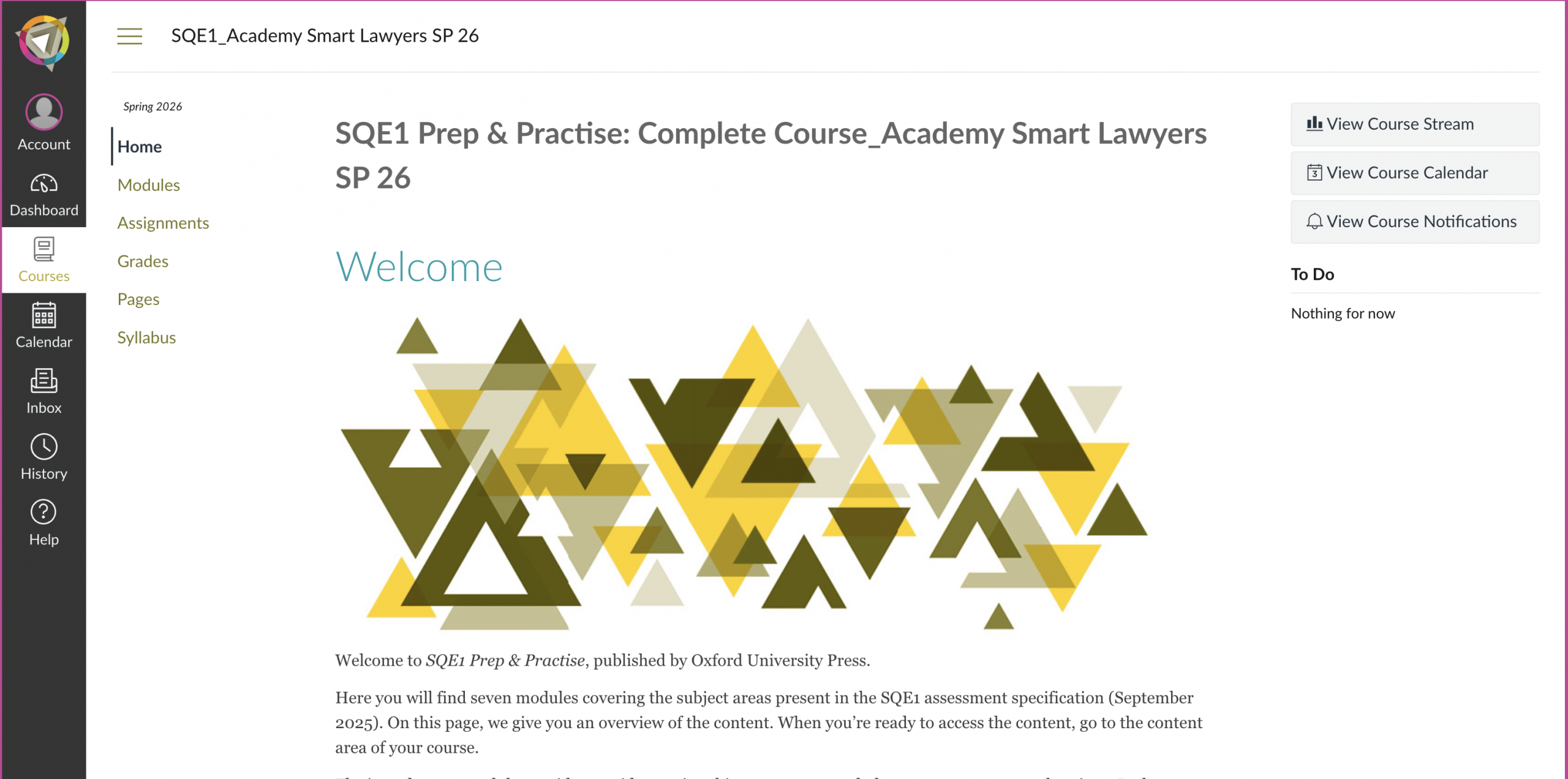
From a technical perspective, Oxford University Press delivers its SQE1 self-study books and manuals through a combination of:
- the established Instructure educational platform, and
- Oxford University Press’s own integrated publishing and legal educational technology.
➽ digital textbooks,
➽ syllabus progression,
➽ chapter testing,
➽ internal cross-referencing,
➽ visual learning aids, and
➽ broader legal study resources.
For self-studying candidates, this matters. A poorly organised platform can quickly undermine independent study, create unnecessary confusion, and make it harder to track genuine progress.
By contrast, OUP offers a more structured legal educational framework, while also providing useful opportunities for candidates to monitor their own performance and, in certain assessment areas, compare themselves against broader user benchmarks. This can be particularly valuable for SQE self-study candidates, as it offers not only legal learning, but also a clearer sense of how their preparation may align with others preparing for the same demanding professional assessment.
Oxford University Press SQE Course Structure: How the SQE1 Self-Study Manual Is Organised
For candidates considering SQE self-study, additional SQE1 self-preparation, or independent legal revision, course structure is critical. Even strong legal content can lose significant value if the syllabus is poorly organised.
One of the major strengths of Oxford University Press SQE Prep & Practice is that its course structure is generally logical, academically coherent, and relatively easy to follow for self-studying SQE candidates.
SQE1 Syllabus Coverage Through Structured Subject Modules
The full Oxford University Press SQE Prep & Practice course begins with FLK1, and its first major subject area is Business Law and Practice.
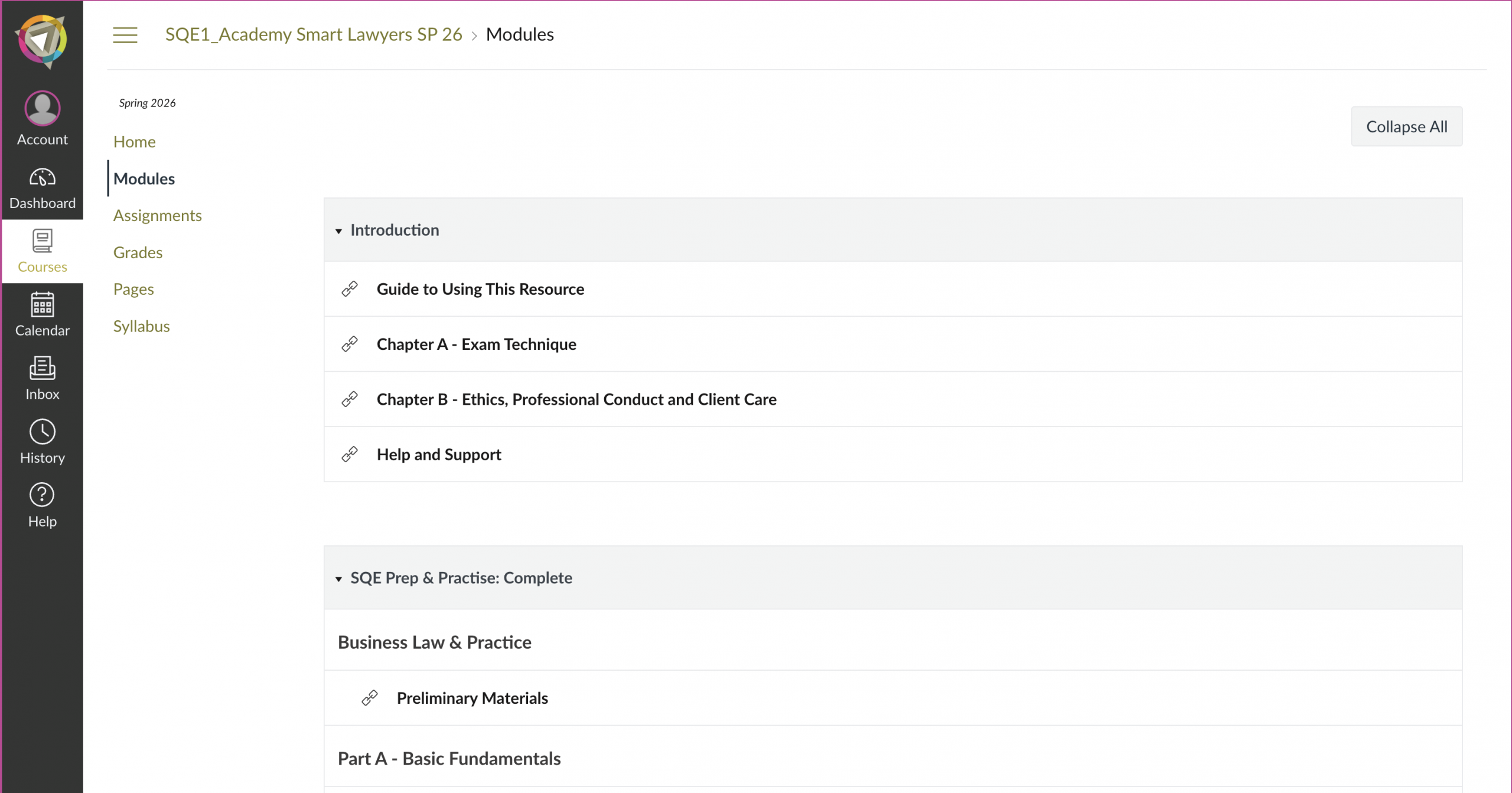
This is a logical and academically sensible starting point. Business Law is one of the largest and often more demanding components of the SQE1 syllabus, particularly for candidates who may come from non-commercial, foreign, or purely academic legal backgrounds. It covers substantial areas of corporate structures, governance, finance, and compliance, making it one of the foundational pillars of practical legal knowledge within the SQE framework.
Beginning with Business Law allows candidates to engage early with one of the broadest and professionally significant subject areas, either tackling it strategically from the outset or building confidence by confronting one of the larger syllabus areas first.
From there, Oxford University Press structures the course broadly in line with the wider FLK1 framework, grouping subjects in a way that reflects the logic of the SQE syllabus itself. After Business Law, candidates move into broader dispute-related legal groupings, including Contract Law, Tort Law, and Dispute Resolution / Civil Litigation. This progression is particularly practical because these subjects are deeply interconnected both academically and in legal practice.
The course then continues through further FLK1 areas such as Constitutional and Administrative Law, Legal Services, and Ethics and Professional Conduct, before progressing later into FLK2 subjects such as Property, Land Law, Wills, Trusts, Criminal Law, and Solicitors Accounts.
This syllabus-aligned grouping is one of OUP’s notable strengths for SQE self-study candidates.
Rather than presenting legal subjects as fragmented standalone disciplines, Oxford University Press reflects the broader structure of the actual SQE assessment, helping candidates:
- progress systematically,
- understand legal interconnections,
- reduce revision uncertainty, and
- build knowledge in a more professionally coherent way.
By organising materials in broader legal clusters, OUP better prepares candidates for this reality. This integrated syllabus structure helps candidates:
- build stronger legal synthesis,
- improve issue spotting across disciplines,
- strengthen practical application, and
- better reflect the true complexity of SQE1 assessment.
For serious self-study candidates, this is a major advantage, as mastering SQE1 is not simply about memorising isolated legal rules, but about developing the ability to apply multiple related areas of law simultaneously under exam conditions.
How Often OUP SQE Materials Are Updated?
- Oxford University Press updates its SQE1 resource approximately once per year
- Updates are usually released around August or September
- The stated aim is to align materials with the latest SRA specification
- Updates are intended to support both January and July SQE1 sittings
This is an important consideration given the continuing evolution of the SQE syllabus and assessment framework
Oxford University Press SQE MCQs and Mock Exams: How Effective Are OUP Practice Questions for SQE Self-Study?
For candidates pursuing SQE self-study, SQE1 self-preparation, or independent revision, the quality of multiple-choice questions (MCQs) and mock exams is often one of the most important factors when evaluating SQE books and manuals.
Legal textbooks alone are rarely enough. The SQE1 assessment is heavily based on single best answer multiple-choice questions, and candidates must develop not only legal knowledge, but also:
- practical issue spotting,
- exam strategy,
- legal synthesis,
- stamina, and
- question technique.
This makes the quality of provider practice questions highly significant.
Chapter-Based SQE1 MCQs: Structured Legal Reinforcement
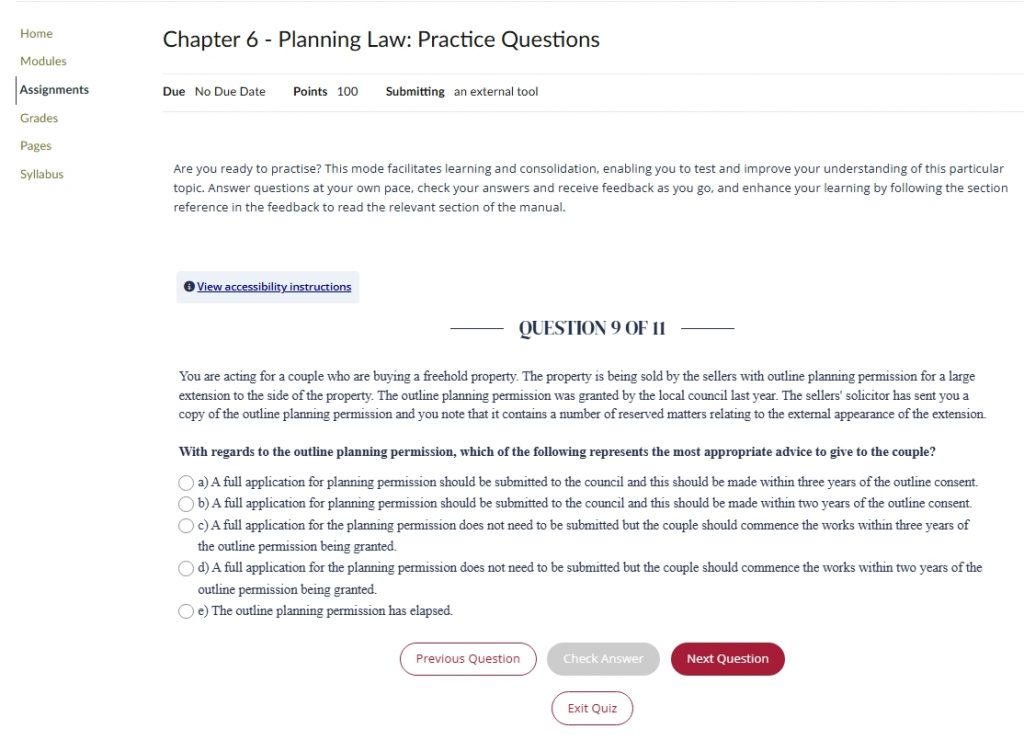
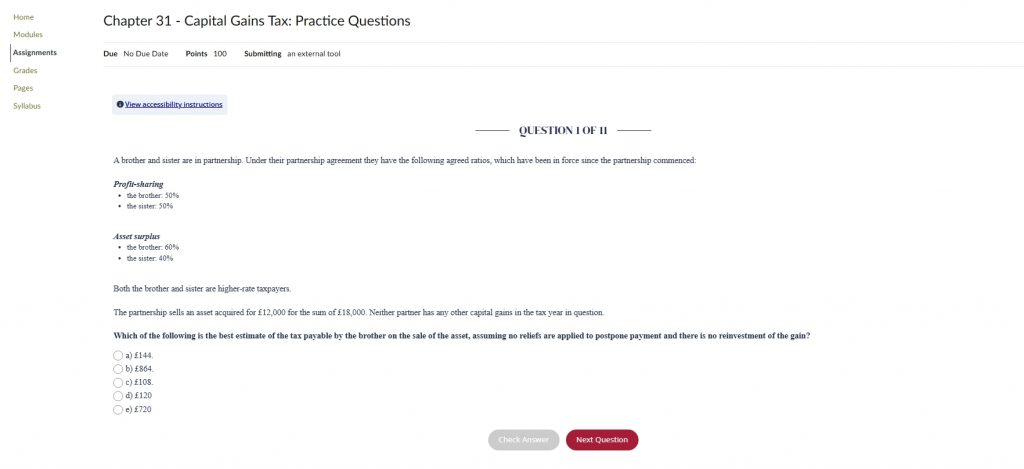
One of OUP’s key strengths is that most chapters include integrated topic-specific MCQs, usually averaging: Approximately 10–15 multiple choice questions per chapter
These questions are directly tied to the legal content just covered. Practical benefits include:
Immediate reinforcement of legal principles
- Active recall
- Early weakness identification
- Better retention
- More structured self-study progression
For self-studying candidates, this chapter-by-chapter approach is highly useful because it transforms reading into active revision.
Accessible SQE MCQ Design: Advantage for SQE Self-Study
Oxford University Press’s chapter-based MCQ system does not fully replicate the exact visual interface of the real SQE1 assessment platform.
Importantly, however, this may actually function as a practical advantage rather than a weakness for many candidates.
The real SQE exam interface has often been criticised by candidates for its comparatively outdated design features, including:
- smaller font sizes,
- dense text presentation,
- visually compressed layouts, and
- extended on-screen reading demands.
Many candidates report that prolonged use of the actual exam system can be physically tiring, less user-friendly, and in some cases more visually straining than modern educational platforms.
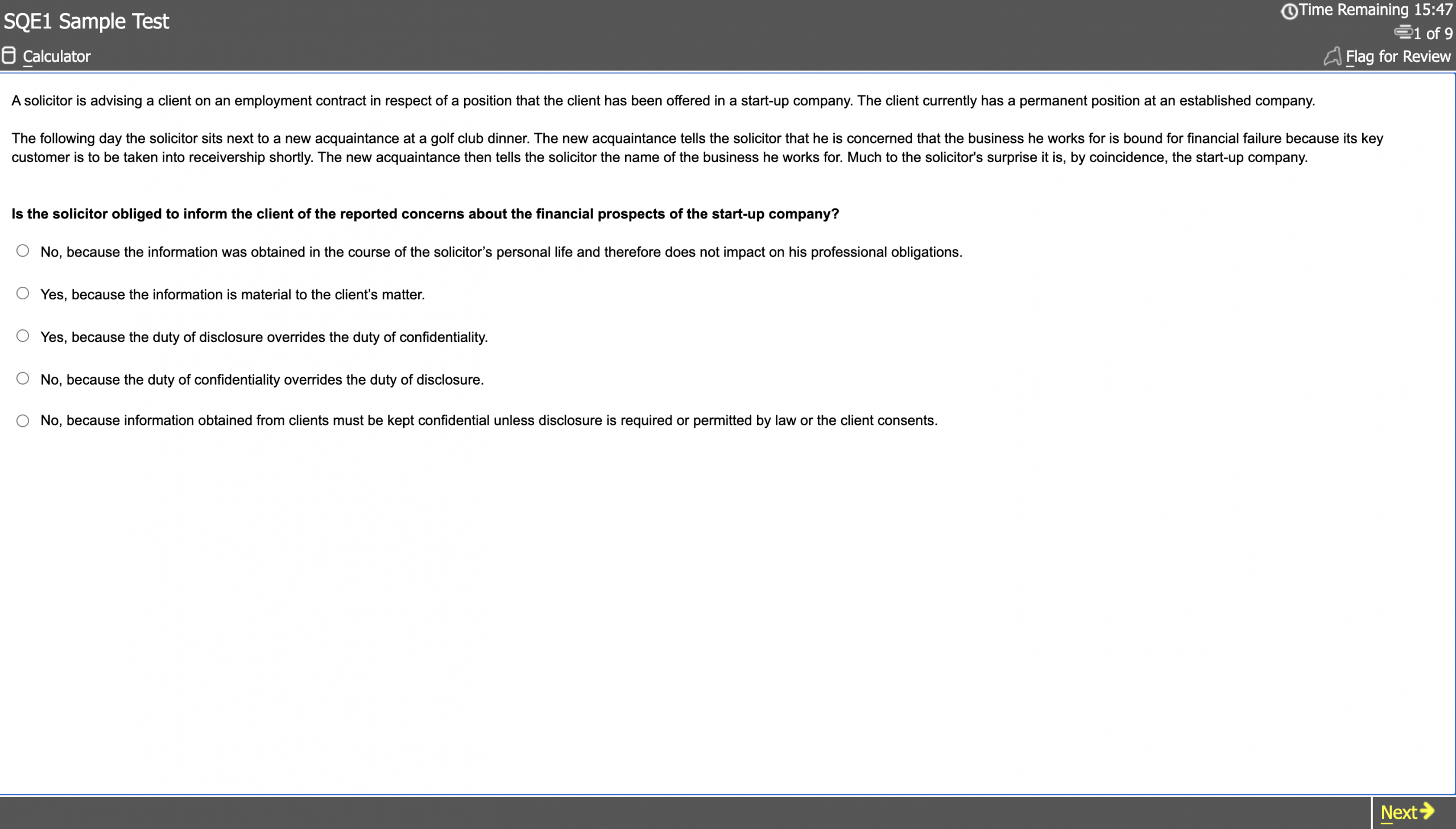
⇲ Try SQE1 exam functionality on Pearson VUE (English)
While candidates ultimately have no choice regarding the official assessment environment, this makes preparation conditions particularly important.
When preparing for SQE1, candidates may spend hundreds of hours answering multiple-choice questions on screen. In this context, Oxford University Press’s more accessible digital design may offer significant practical benefits.
OUP advantages include:
- Larger fonts
- Better readability
- More comfortable visual spacing
- Improved accessibility tools
- Adjustable display features
- Reduced eye strain during extended revision sessions
For long-term SQE self-study, this matters. A preparation platform that is easier to read and less visually exhausting may:
- improve concentration,
- reduce fatigue,
- support longer revision sessions,
- and create a more sustainable study environment.
This does not remove the need for candidates to eventually familiarise themselves with the official exam interface. However, for the substantial volume of daily preparation required, a more user-friendly system can be a considerable advantage.
In practical terms, Oxford University Press prioritises educational usability during the learning process, while still maintaining legally relevant MCQ structure.
For many candidates, particularly those spending extensive periods in front of a screen, this may significantly improve the overall SQE self-study experience by supporting better concentration, reducing unnecessary visual fatigue, and potentially lowering some of the strain associated with prolonged screen exposure. While no digital platform entirely removes the health considerations of intensive study, a more accessible and visually considerate design may help reduce avoidable eye strain during the substantial preparation hours often required for SQE success.
SQE MCQ Quality Review: OUP Practice Questions Are Professionally Drafted
When evaluating SQE MCQs, SQE mock exams, and SQE self-study question banks, one of the most important factors is not simply quantity, but drafting quality.
Based on both structural analysis and practical candidate feedback, OUP’s multiple-choice questions generally give the impression of being professionally and carefully human-written, rather than relying excessively on simplistic automated generation.
Why Human-Written SQE MCQs Still Matter?
Modern AI can certainly assist with legal educational drafting. It can:
- summarise law,
- suggest legal issues,
- help restructure materials, and
- support content production.
However, genuinely high-quality SQE multiple-choice questions require a far more advanced drafting process. The most difficult part of quality MCQ creation is often not the legal question stem itself. The real complexity lies in:
- constructing credible distractors,
- balancing plausible legal alternatives,
- reflecting subtle legal distinctions,
- and designing options that genuinely test legal judgment.
This is where purely AI-generated systems often remain weaker without substantial expert oversight. For strong SQE MCQ quality assurance:
- AI may assist,
- solicitor-tutor review is essential,
- and the highest standards are usually achieved when solicitor-tutors directly draft or heavily supervise content.
Oxford University Press’s MCQs generally reflect this higher professional drafting standard.
Candidate Feedback on OUP SQE MCQs
Our own candidates who have used Oxford University Press materials have generally provided strong feedback regarding question quality.
For example, we received particularly positive feedback from a foreign-qualified candidate who struggled significantly with dispute resolution due to confusion between differing legal systems and procedural structures. In that particular case:
OUP’s disputes MCQs were reported to have been especially valuable in clarifying English procedural logic, reinforcing understanding of court structures, improving broader comprehension of the legal system, and significantly reducing confusion for a foreign-qualified candidate navigating unfamiliar procedural frameworks.
This is an important practical strength.
SQE1 Mock Exam Quality
Feedback regarding OUP’s larger mock exams has also generally been positive.
Candidates have reported that:
- question quality was strong,
- legal complexity was credible,
- performance testing felt valuable,
- and broader exam comparison was useful.
While no provider can perfectly replicate the live SQE, OUP’s mock exams have often been viewed as professionally comparable in overall educational quality.
Final Thoughts: OUP Subscription, Provider Selection, and Practical SQE Self-Study Strategy
When selecting SQE books, SQE manuals, or SQE self-study resources, candidates should always look beyond marketing and examine what sits behind the product itself.
This means asking important questions such as:
- Who actually wrote the materials?
- Are the tutors or authors legally qualified?
- Do they have genuine UK legal education and practice experience?
- Is the content professionally drafted or heavily AI-generated?
- What specific purpose does the resource serve best?
This is increasingly important in the modern SQE market.
Some providers may offer useful resources for certain functions, such as summaries, or broader revision support, while relying more heavily on AI-generated content for other areas. While AI may be useful in some educational contexts, candidates should remain particularly cautious when evaluating SQE MCQs, where question quality, legal nuance, and professionally drafted answer options remain critical.
Oxford University Press Subscription Options
Oxford University Press SQE Prep & Practice is primarily delivered through digital subscription access, offering flexibility for candidates pursuing SQE self-study, SQE1 self-preparation, or independent legal revision.
Standard Oxford University Press options generally include:
This structure may suit:
- self-preparing candidates,
- working professionals,
- foreign SQE candidates,
- and part-time learners.
Oxford University Press SQE Prep & Practice: Key Advantages and Disadvantages
The right resource is not always about what is objectively “best,” but rather what is best suited to your own preparation strategy.
1) Comparatively Concise Legal Text Compared to Larger Manuals: Oxford University Press materials are generally more concise than some larger competitors.
Potential advantages:
- Easier to digest
- More manageable for self-study
- Reduced cognitive overload
- Faster progression through syllabus
- Better suited for candidates balancing work or time constraints
- Stronger for structured revision
Potential disadvantages:
- Less detailed than larger manuals
- Some candidates may want deeper legal explanation
- May require supplementary reading for difficult topics
- Certain learners may prefer broader textbook depth
Practical perspective: If you prefer focused legal clarity, OUP’s concise style may be highly effective.
2) Fully Electronic SQE Resource: Oxford University Press is primarily a digital educational resource.
Potential advantages:
- Global accessibility
- Immediate online access
- No shipping delays
- Practical for international candidates
- Searchable content
- Interactive tools
- More environmentally sustainable
- Accessibility features
- Portable study across devices
Potential disadvantages:
- Limited subscription duration
- Not permanent ownership
- Reduced hard-copy flexibility
- Limited printing options
- Device dependency
- Less suitable for candidates who strongly prefer physical textbooks
- Practical perspective:
For modern global candidates, digital flexibility is often a major advantage. For traditional learners who prefer paper-based study, this may be less ideal.
OUP Discount for SQE Self-Study Candidates Through the Academy’s Subscription Arrangement
Through our provider arrangements, we are able to offer additional flexibility for candidates seeking structured SQE self-study resources through Oxford University Press.
Through us, candidates may access:
This extended 18-month subscription option can be particularly valuable for:
- candidates preparing over longer timelines,
- part-time students,
- resitters,
- working professionals, and
- international candidates balancing study with other obligations.
At the Academy of Smart Lawyers, we understand from direct first-hand legal education and QLTS/SQE training experience how financially demanding and academically intensive these qualification routes can be.
⚠️ Important: As our operations are based in Singapore, applicable GST at 9% shall apply. This may still represent a practical financial advantage for many candidates when compared with standard UK VAT rates of 20%, particularly for international or Asia-based SQE self-study candidates seeking cost-effective access to Oxford University Press resources.
For many candidates — particularly those based in Asia or pursuing independent study — this may still offer a practical and cost-effective route to one of the most academically credible SQE manuals currently available.
Disclaimer: This review has been produced independently and reflects our unbiased assessment of the materials. Our discount arrangement with Oxford University Press (OUP) has not influenced the conclusions or opinions expressed in this review. The review is also informed by feedback received from our students who have used the materials in their SQE preparation.
If you are interested, feel free to contact us at info@superexam.uk or complete our enquiry form: